

SoFloBPH · Advancing prostate care

Research and
Clinical Trials

Exploring the next chapter of prostate care through clinical research into Aquablation therapy for localized prostate cancer.

Investigational use only for prostate cancer. Aquablation is an established treatment for BPH (an enlarged prostate), but its use to treat prostate cancer is investigational. The AQUABEAM and HYDROS systems are not indicated for prostate cancer treatment globally. FDA permission to conduct a study is not approval to market a prostate cancer treatment.

Dr. Christopher Tallman, Founder of SoFloBPH and Principal Investigator
Physician. Researcher. Principal Investigator.

Dr. Christopher Tallman

MD, MS · Founder of SoFloBPH

A leading urologist in Aquablation BPH surgery and an active clinical researcher, Dr. Tallman brings experience in minimally invasive robotic surgery to the study of new approaches to prostate cancer care.

He serves as Principal Investigator for WATER IV, comparing Aquablation with radical prostatectomy, and the WATER IV AS Sub-study, comparing Aquablation with active surveillance.

These studies ask whether an image-guided, robotic waterjet approach can control localized prostate cancer while evaluating urinary function, sexual function, and quality of life. Benefits for prostate cancer have not yet been established.

The WATER IV clinical program

Two studies. Different comparisons.

Both randomized studies evaluate investigational Aquablation therapy and follow participants for up to ten years. Randomization means treatment is assigned by chance rather than chosen by the participant.

WATER IV RP · NCT06651632

Aquablation vs.
radical prostatectomy

Studies safety and efficacy in men with Grade Group 1–3 localized prostate cancer who are candidates for, or have already selected, surgery.

Study treatments
Aquablation removes prostate tissue through the urethra using image guidance and a robotic heat-free waterjet. Radical prostatectomy removes the entire prostate and may also remove surrounding tissue.
Assignment
Randomized 3:1 — Aquablation therapy to radical prostatectomy, according to the WATER IV patient website.
Enrollment milestone
PROCEPT reported completion of enrollment of all 280 planned patients on May 28, 2026. This is not an invitation to enroll in the completed RP cohort.
Follow-up
Ten years, assessing disease control and quality-of-life outcomes.
WATER IV AS · NCT07650448

Aquablation vs.
active surveillance

Studies safety and efficacy in men with low- to intermediate-risk localized prostate cancer who are candidates for active surveillance.

Study comparison
Aquablation therapy versus active surveillance — a structured approach to monitoring prostate cancer rather than treating it immediately.
Planned enrollment
333 participants. The registry lists the study as recruiting in its November 6, 2026 update; availability at individual sites must be confirmed.
Selected eligibility criteria
Biological males age 45 or older; biopsy-confirmed Grade Group 2 disease or Grade Group 1 disease with an MRI-visible lesion; initial diagnosis within 18 months; candidates for active surveillance. Additional clinical and exclusion criteria apply.
Follow-up
Up to ten years. PROCEPT’s announcement describes biopsy assessment at one year and MRI-based whole-gland evaluation at three years.

Eligibility is determined by the study team after reviewing the full protocol, medical history, imaging, PSA, and biopsy findings. A brief summary cannot determine whether someone qualifies.

Research update · May 28, 2026

PROCEPT advances its prostate cancer program

PROCEPT BioRobotics announced completion of enrollment in the randomized WATER IV RP study and FDA Investigational Device Exemption (IDE) approval for the additional WATER IV AS randomized protocol.

The company said it expects to present the RP study’s primary endpoint results at the American Urological Association Annual Meeting in spring 2027. This is a planned timeline, not a report of results.

The AS study explores whether earlier intervention with Aquablation could offer an option for men otherwise managed with active surveillance. Both protocols evaluate disease control alongside urinary, sexual, and overall function over time.

The May 2026 announcement reports study milestones and research goals, not proof that Aquablation is effective for prostate cancer.

Read PROCEPT’s full announcement
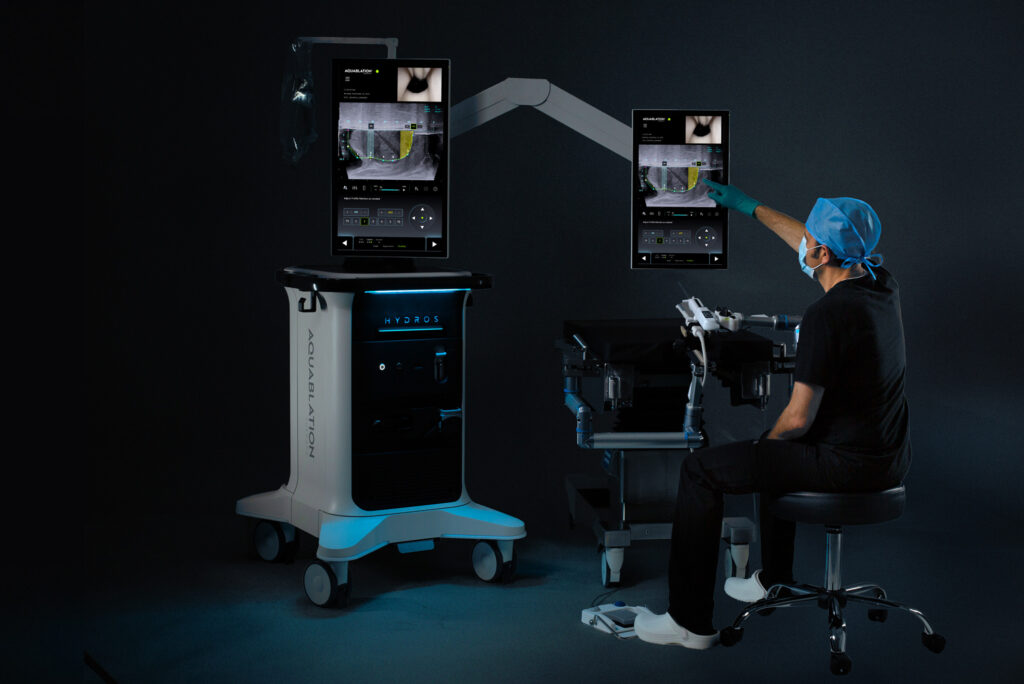
HYDROS Robotic System used to deliver Aquablation therapy
HYDROS Robotic System. Image: PROCEPT BioRobotics. Prostate cancer use remains investigational.
Considering clinical research?

A conversation starts with your care team.

Participation is voluntary. Before joining a study, you receive study-specific information and sign an informed consent form. The team reviews your medical records to confirm eligibility, explains randomization, and discusses procedures, follow-up visits, possible risks, and alternatives.

All surgical treatments carry risks. Potential benefits are not guaranteed, and research may involve additional testing and visits. Ask how participation could affect your current treatment plan, costs, travel, and long-term follow-up.

Aquablation for prostate cancer is available only within authorized clinical research, not as routine prostate cancer treatment. Do not delay recommended cancer care while considering a trial.

Contact our research coordinator

Quacian Dennis

Research Coordinator

(954) 357-3614qdennis@advancedresearchfl.com

Schedule with Dr. Tallman

Text Dr. Tallman directly to have one of his team members call you to schedule a consultation.

Text only · (954) 608-6825

Text Dr. Tallman’s team

Ask about the WATER IV AS Sub-study and current local availability. A consultation does not guarantee eligibility or enrollment. Please do not include medical records or sensitive health details in your initial text.

Sources and study information

Information reviewed November 10, 2026. Study status, eligibility, and projected timelines can change. This page is educational and is not a substitute for individualized medical advice.

Call NowSymptom Quiz